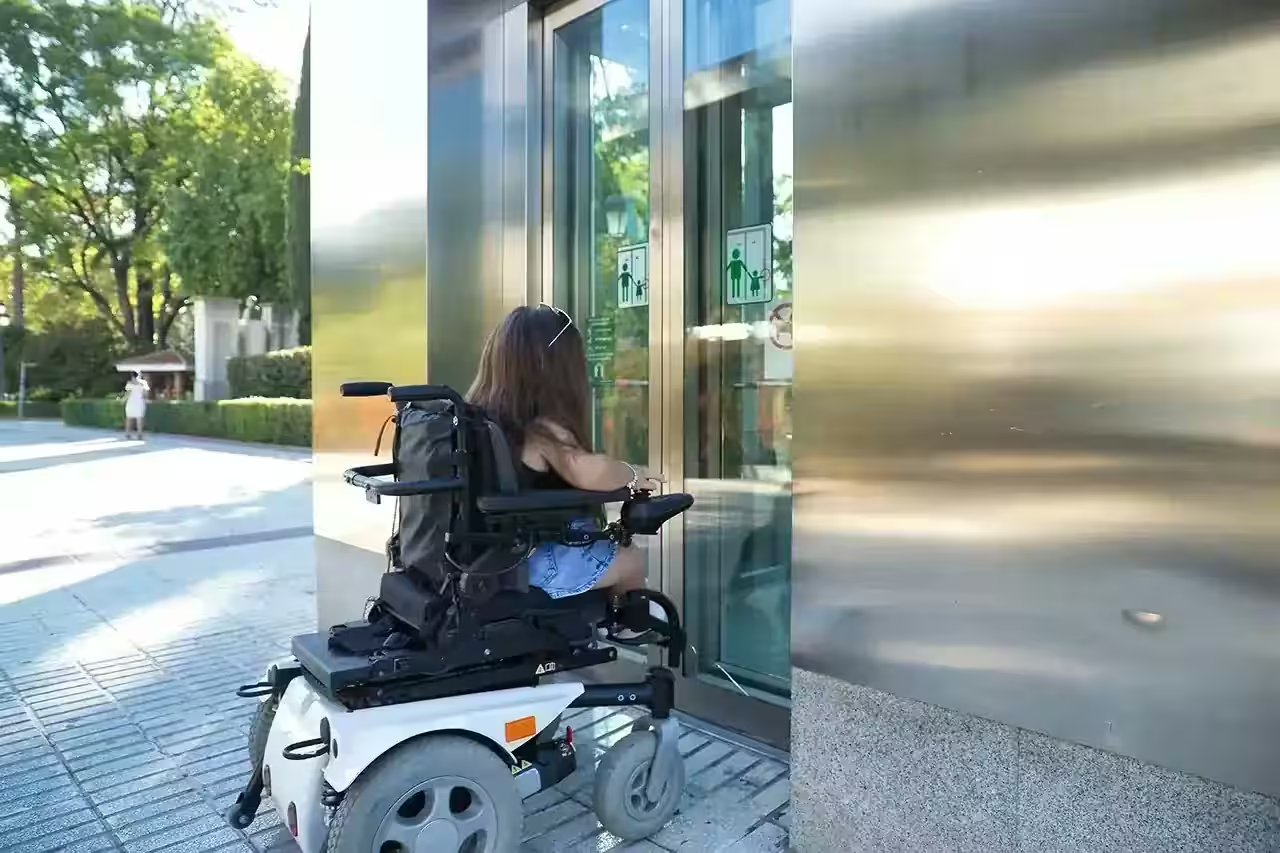
Accessible travel planning starts with matching destinations and accommodations to your family's specific needs — from wheelchair access and sensory-friendly environments to dietary requirements and medical considerations — and a specialized travel advisor can coordinate it all at no extra cost.
If you've ever planned a trip around a wheelchair, a feeding schedule, a sensory sensitivity, a behavioral support plan, or a medical device — you already know that most travel advice isn't written for you.
The blog posts say "just go!" The Instagram captions say "adventure awaits!" And you're sitting there thinking: Sure, but does the resort have a roll-in shower? Will the airline let us pre-board? Is there anywhere quiet my kid can go when it gets to be too much? Will the staff actually understand, or will they just stare?
I get it. Not in a "I read an article about accessibility" way. In a "I'm a mom of two kids on the autism spectrum and I've navigated this myself" way. I'm based in the Rockford area and serve families throughout Northern Illinois and the greater Stateline region. Accessible and inclusive travel planning is personal for me. It's also one of the things I do best.
What "Accessible Travel" Actually Means
Accessibility isn't one thing. It's a spectrum — no pun intended — and it looks different for every traveler and every family. It might mean:
- Mobility accommodations. Wheelchair-accessible rooms, roll-in showers, pool lifts, accessible transportation, flat terrain at resorts and attractions.
- Sensory considerations. Quiet spaces, low-stimulation environments, noise-canceling headphone-friendly attractions, accommodations for light sensitivity or crowd aversion.
- Cognitive and developmental support. Visual schedules, social stories for new experiences, staff who understand neurodivergence, flexible dining options for restricted diets, and the ability to leave an activity without penalty or judgment.
- Deaf and hard-of-hearing needs. Hearing-accessible hotel rooms with flashing light alerts and visual door signals, TTY phones, assistive listening devices, closed captioning, and staff trained to communicate in writing when needed. This is a distinct category — not a subset of sensory processing.
- Blind and low-vision considerations. Braille menus and signage, sighted guide assistance, audio descriptions at attractions, and destinations with strong auditory navigation cues.
- Medical needs. Refrigeration for medications, proximity to hospitals, resorts with on-site medical staff, airlines that accommodate medical equipment, and travel insurance that covers pre-existing conditions.
- Dietary requirements. Severe allergies, feeding tubes, texture sensitivities, religious dietary needs, or medical diets that go beyond "gluten-free option available."
A truly accessible vacation accounts for all of this before you leave home — not as a series of problems to solve on the fly when you get there.
Why Most Travel Planning Falls Short
Resort websites say "accessible" without explaining what that means. An "accessible room" at one resort might be a fully adapted suite with a roll-in shower, grab bars, and a lowered vanity. At another, it might mean there's a grab bar next to the toilet and that's it. The label is the same. The experience is wildly different.
Theme parks have programs that most families don't know about. Disney's Disability Access Service, Universal's Accessibility Center, cruise line special needs coordinators — these programs exist and they're genuinely helpful. But the rules change regularly, the registration processes can be confusing, and the information online is often outdated or contradictory.
"Family-friendly" doesn't mean "every family." A resort can be phenomenal for neurotypical kids and a disaster for a child with sensory processing differences. A cruise ship can be wonderful for an active senior and impossible for someone in a wheelchair who can't navigate the tender boats at certain ports. The broad marketing doesn't capture these distinctions.
Airlines vary enormously in how they handle accommodations. Pre-boarding policies, medical equipment allowances, seat assignment flexibility, in-flight support — it's different on every airline. Knowing which carriers do this well matters.
Most travelers don't know the laws that protect them. There are federal laws that guarantee your rights as a traveler with disabilities — and knowing what airlines, airports, and transportation providers are required to do changes the entire dynamic.
Deaf travelers are frequently overlooked — even by accessibility-focused advisors. The Sunflower Lanyard, TSA Cares, accessible hotel rooms with visual alert systems — these exist specifically for non-visible disabilities including hearing loss, but most travel content skips right past them.
Know Your Rights: Laws That Protect Travelers with Disabilities
Before we get into planning strategies, I want to make sure you know about the legal protections that exist. This isn't about being adversarial — it's about knowing what you're entitled to so you can advocate for your family from an informed position.
The Air Carrier Access Act (ACAA)
The ACAA is a federal law that prohibits airlines from discriminating against passengers on the basis of disability. It applies to all U.S. airline flights and to flights to or from the United States on foreign carriers. Under the ACAA:
- Airlines cannot refuse to transport you because of your disability. If a carrier excludes someone on safety grounds, they must provide a written explanation.
- Airlines cannot require advance notice that a person with a disability is traveling — with limited exceptions for certain accommodations that require preparation.
- Airlines cannot require a person with a disability to travel with a companion except in very specific, limited safety circumstances. And if the airline insists on a safety assistant, they cannot charge for that person's ticket.
- Airlines cannot assign you to a specific seat solely because of your disability (except for FAA exit-row safety requirements).
- Airlines must provide assistance with boarding, deplaning, and connections — including wheelchair assistance and help stowing assistive devices.
- Every airline must have a Complaints Resolution Official (CRO) available to handle disability-related issues. You have the right to speak with this person if a problem arises.
- Deaf and hard-of-hearing passengers who self-identify are entitled to accessible communication — including written or visual notification of gate changes, delays, and boarding information.
The DOT also published the Airline Passengers with Disabilities Bill of Rights, which outlines ten fundamental rights including the right to be treated with dignity, the right to accessible airport facilities, and the right to resolution of disability-related issues. Download it at transportation.gov before you fly.
The Americans with Disabilities Act (ADA)
While the ACAA covers what happens on the aircraft, the ADA covers airport facilities themselves — terminals, check-in counters, restrooms, gates. If you encounter an accessibility barrier at the airport, that's the ADA. You can file a complaint with the airport, the FAA's Airport Disability Compliance Program, or the Department of Justice.
Worth knowing: hotels in the U.S. are required under the ADA to set aside a certain number of hearing-accessible rooms with visual alert systems, TTY phones, and bed-shaking or light-flashing emergency alarms. Request one specifically when you book — don't leave it to chance at check-in.
Knowing these laws doesn't mean you'll need to cite them. But it changes the conversation. When something goes wrong, ask for the CRO, document the issue, and file a complaint with the DOT if necessary.
Navigating Airports: Programs Most Families Don't Know About
The airport is often the most stressful part of accessible travel — especially for families with kids who have sensory sensitivities, anxiety about new environments, or medical equipment that complicates security screening.
TSA Cares
TSA Cares is a free helpline specifically for travelers with disabilities, medical conditions, and other special circumstances. Call (855) 787-2227 at least 72 hours before your flight, or submit a request through TSA's website. When you contact TSA Cares, they can arrange for a Passenger Support Specialist — a specially trained TSA officer — to meet your family at the security checkpoint and walk you through the screening process. This is particularly valuable for:
- Children on the autism spectrum who may struggle with the unpredictability of security screening
- Travelers with medical devices, ports, ostomy pouches, or catheters
- Families traveling with medically necessary liquids over the standard 3.4 oz limit (these are allowed — but you need to declare them)
- Anyone who has difficulty following verbal instructions due to a disability
- Deaf or hard-of-hearing travelers who want a patient, informed point of contact through the checkpoint process. You do not need to remove hearing aids or cochlear implants at security, and you're not required to communicate verbally — you can use a written notification card instead.
The Hidden Disabilities Sunflower Lanyard
The Sunflower Lanyard is a simple green lanyard with yellow sunflowers that signals to trained staff that the wearer has a non-visible disability and may need extra time, patience, or assistance. Originally launched at London's Gatwick Airport in 2016, it's now recognized at over 250 airports across 35 countries — and growing.
You don't need to explain your disability. You don't need documentation. You simply pick up a free lanyard at a participating airport (usually at an information desk or customer service counter), and staff who've been trained on the program will know to offer a bit more patience. For families with autism, ADHD, anxiety, chronic pain, or any other condition that isn't immediately visible — including hearing loss — this small tool can reduce the number of times you have to explain your situation to strangers.
Several airlines now recognize the Sunflower program, including Lufthansa, SWISS, Austrian Airlines, Eurowings, and Jetstar, with more joining regularly. Ask your airline about it when you book.
Airport Sensory Rooms and Hearing Loops
A growing number of airports now offer dedicated sensory rooms — calm, low-stimulation spaces designed for travelers who feel overwhelmed by the noise and chaos of a busy terminal. Seattle-Tacoma International Airport was a U.S. pioneer, and more airports are following. These rooms are typically free and open to anyone who needs them. Check the accessibility page before you travel so you know exactly where to go if you need it.
For deaf and hard-of-hearing travelers: some airports are equipped with audio induction loops (also called hearing loops) throughout terminals. These send a wireless signal directly to hearing aids or cochlear implants set to the T or Telecoil setting, cutting through background noise. If your airport has them and you use a compatible device, check hearingloop.org before you travel.
Travel Rights for Deaf and Hard-of-Hearing Travelers
This section deserves its own space because hearing-related needs are consistently underserved in accessible travel guides — including most of the ones I've read.
Under the ACAA, if you self-identify as deaf or hard of hearing to airline personnel at the ticketing counter, gate area, or customer service desk, the airline is required to provide accessible communication — including written or visual notification of gate changes, delays, boarding announcements, and other time-sensitive information. You have to ask. But once you do, they're required to deliver.
At security: You do not have to remove hearing aids or cochlear implants. You're not required to communicate verbally. You can hand TSA a written notification card explaining your hearing status. If your device triggers the screening technology, additional screening may be required — but your device won't be sent through the scanner or confiscated.
At hotels: ADA-covered properties in the U.S. must make hearing-accessible rooms available — rooms with visual door alerts, phone amplification, TTY access, and bed-shaking or flashing-light fire alarms. Request one explicitly when you book.
For international travel: Notify your Video Relay Service provider before you go. Some VRS services have limited coverage abroad, and knowing your communication options in advance — not during an emergency — is the right time to figure that out.
Travel Insurance: What Families with Medical Needs Must Know
For families with medical needs or pre-existing conditions, the details matter — and getting them wrong can mean the difference between a covered claim and a denied one.
The Pre-Existing Condition Waiver — Timing Is Everything
Most standard travel insurance policies exclude pre-existing conditions. To qualify for a waiver:
- Purchase your insurance within 14–21 days of your first trip deposit. Miss this window and that coverage is gone — no exceptions.
- Insure the full non-refundable cost of your trip at the time of purchase. If you add costs later, you typically need to update your policy within 14 days.
- You must be medically stable at the time of purchase. This means no recent changes to your condition, treatment, or medications during the insurer's look-back period (usually 60–180 days before purchase).
- You must be medically able to travel on the day you buy the policy. If there's any question, get written clearance from your doctor.
What's Typically Not Covered — Even with a Waiver
Even with a pre-existing condition waiver, most travel insurance providers exclude:
- Mental health conditions — including anxiety, depression, and bipolar disorder. This is a significant gap for many families.
- Psychological and cognitive disorders — including Alzheimer's and dementia.
- Normal pregnancy (though pregnancy complications may be covered).
If a family member has a mental health condition that could affect your ability to travel, ask the insurance company directly. Don't assume.
Practical Tips for Buying Travel Insurance
- Buy insurance the same day you make your first trip payment. Don't wait.
- Don't rely solely on credit card travel insurance. Most credit card policies lack robust medical coverage and typically exclude pre-existing conditions. Some premium cards (like Amex Platinum or Chase Sapphire Reserve) do include medical evacuation — worth checking, but not as a substitute for a real policy.
- Look for 24/7 emergency assistance services. Quality plans offer a round-the-clock helpline that can coordinate medical care, provide translation, and arrange evacuation if needed.
- Keep medications in original containers in your carry-on. This protects you if luggage is lost and avoids issues at customs or security.
- Check whether your destination has drug import regulations that could affect your medications. Some countries restrict certain pharmaceuticals that are common in the U.S.
Mistakes I See Families Make (And How to Avoid Them)
"Accessible room" doesn't mean the same thing everywhere. Before you book, ask specifically: Does the room have a roll-in shower or a tub with a seat? What are the door widths? Is there a pool lift? Get it in writing.
Not disclosing your needs early. Waiting until arrival to mention a wheelchair, a severe allergy, or a hearing accommodation dramatically limits what a property can do. The earlier you disclose — in writing, confirmed — the better the experience. You're not asking for special treatment. You're giving them the information they need to do their job.
Not confirming accommodations before arrival. You requested a ground-floor room, noted your child's allergies, flagged the need for a refrigerator for medication. That request lives in a reservations system. It may or may not have been communicated to the property. I call ahead — before every trip — to confirm that someone at the resort or ship actually knows what's coming.
Waiting too long to buy travel insurance. The window for a pre-existing condition waiver is 14–21 days from your first trip deposit. Miss it, and that coverage is gone. Buy insurance the same day you make your first payment.
Overpacking the schedule. Accessible travel needs margin. Rest days, shorter touring windows, backup quiet options for high-stimulation moments. The right itinerary for your family is probably 20–30% less packed than you think it should be.
Assuming international infrastructure is like home. In much of the world, the ADA doesn't exist. Cobblestone streets, stairs without ramps, bathrooms that aren't accessible, and limited medical facilities are real considerations for many destinations. It doesn't mean international travel is off the table — it means it requires a different level of research and expectation-setting.
Not asking about tender ports on cruises. If you use a wheelchair and your itinerary includes ports where passengers board small boats to reach shore, those boats may not be wheelchair accessible. I flag every tender port before my clients book a cruise so that decision is made with full information — not discovered the morning of a port day.
Assuming hearing and vision needs will "just be figured out." Deaf and hard-of-hearing travelers should request hearing-accessible rooms specifically (with visual alert systems) — not just any accessible room. Blind and low-vision travelers should confirm Braille menus, sighted guide availability, and audio description options before booking, not after arrival.
Does Accessible Travel Cost More?
Sometimes yes, sometimes no. Worth being clear-eyed about which is which.
Where costs are typically the same: Disney's disability programs, cruise line accessibility coordinators, TSA Cares, the Sunflower Lanyard program, pre-boarding assistance, sensory guides at theme parks — none of these cost extra. My planning services are also free; I'm paid by the travel suppliers, not by you. That's true whether you're based in Rockford, the Stateline area, or anywhere in Northern Illinois.
Where costs may be higher: Accessible staterooms and resort rooms are sometimes priced higher than standard rooms, particularly on cruises where the accessible cabin category is limited. Private airport transfers instead of shared shuttles cost more but may be necessary for wheelchair users or families who can't rely on public transit. Premium travel insurance that covers pre-existing conditions costs more than basic coverage — but it's often the difference between a $30,000 covered medical claim and a $30,000 out-of-pocket one.
Where planning saves money: Knowing which destinations genuinely deliver on accessibility — versus which ones charge a premium for "accessible" marketing while under-delivering — is where working with someone experienced pays off. I've steered families away from expensive resorts that looked accessible on paper but weren't, and toward comparable or less expensive properties that were genuinely excellent.
Tech and Tools Worth Knowing About
Airline apps for accommodation requests. Most major airlines now let you manage accessibility requests — pre-boarding, wheelchair assistance, meal accommodations — directly in their app. Request as early as possible; don't leave it for the airport. Confirm again 24–48 hours before your flight.
Translation apps for dietary needs. For international travel, apps like Google Translate with the camera function can help you verify ingredients on food labels in real time. Better option: carry a written allergy card in the local language. Organizations like AllergyEats and Select Wisely provide printed cards — more reliable than live translation when you're explaining a severe allergy to kitchen staff.
Noise-canceling headphones. For sensory-sensitive travelers, a good pair of noise-canceling headphones — adult or child-sized — is one of the highest-return items you can pack. Airports, planes, and theme parks are loudest in transitions; headphones give your child a controllable escape valve in those moments.
Visual schedule apps. Apps like Choiceworks and First Then Visual Schedule let you build visual itineraries for travel days and destination experiences that your child can reference independently. For kids who do better with a visual roadmap than verbal explanations, these are worth having loaded before you leave home.
Hearing loop information. If you or a family member uses a hearing aid or cochlear implant with T-coil capability, the Hearing Loop Project (hearingloop.org) maintains a database of venues and airports with installed loop systems. Knowing this in advance — especially for major transit hubs — can make a real difference on travel days.
In-cabin wheelchair travel — watch this space. The FAA has been actively researching whether passengers who use wheelchairs will eventually be able to remain in their own chairs during flights, rather than transferring to airline seats. Delta Flight Products has submitted cabin wheelchair designs for FAA approval. This isn't available yet — but it's closer than most people realize, and it would be a genuine game-changer.
The TSA Cares online form. More reliable than calling in some cases — you get a confirmation and a paper trail. Submit at tsa.gov at least 72 hours before departure.
Destination Spotlights for Accessible Travel
Walt Disney World
Disney has long been one of the most accommodating destinations in the world for neurodivergent travelers and guests with disabilities. The landscape has shifted significantly, though — and families need to plan accordingly.
What's still excellent: Disney's resorts offer accessible rooms across every price tier. Sensory guides for every attraction help you plan around your child's specific triggers. Rider Switch lets one parent ride while the other stays with a child, then swap without re-waiting. Cast members are consistently kind and patient with guests who have visible and invisible disabilities.
What's changed — the DAS program: Disney's Disability Access Service (DAS) underwent major changes starting in 2024 and has continued to evolve. The program now focuses primarily on guests with developmental disabilities like autism who are unable to tolerate extended waits in traditional queue environments. Registration requires a pre-arrival video chat with a Cast Member and a contracted medical professional, up to 60 days before your visit.
The DAS changes have been controversial. A class-action lawsuit (Malone v. Walt Disney Parks & Resorts) alleging ADA violations was filed in early 2025 and remains ongoing. A shareholder proposal calling for an independent review of the DAS program was put to a vote at Disney's annual shareholder meeting on March 18, 2026 — and shareholders voted against it, with approximately 95% siding with Disney's board. New Disney CEO Josh D'Amaro addressed the program at the meeting but made no commitments to change the current approach.
One positive update: DAS is now valid for up to one year (or the length of your ticket, whichever is shorter) — meaning annual passholders and frequent visitors won't need to re-register as often.
What this means practically: Don't plan a Disney vacation around the assumption that your family will receive DAS. Plan as though you won't have it — build in rest days, use Rider Switch, take advantage of early entry benefits that come with staying on property, and identify the attractions your family cares about most. If you do receive DAS, it becomes a bonus rather than a lifeline. This is one of the areas where working with someone who understands the current system makes the biggest difference.
Universal Orlando
Universal's Accessibility Center is a genuine alternative for families who have been denied DAS at Disney — and it's worth understanding how it works. Universal's accommodation program is tied to IBCCES certification (the same organization behind the Beaches Resorts autism-friendly program). Guests can register for a card through the International Board of Credentialing and Continuing Education Standards, which then allows for queue accommodations at Universal parks. The process is different from DAS, but for many families it's a workable option. Ask me how it compares for your specific situation.
Royal Caribbean
Royal Caribbean remains the cruise industry leader in accessibility. Their Autism Friendly program (developed with Autism on the Seas) includes trained staff, sensory-friendly films, priority check-in for families with special needs, and dedicated activities. Newer ships — particularly those in the Icon and Oasis classes — offer significantly better accessibility than older vessels. Pool lifts, accessible staterooms, and wheelchair-friendly public spaces are built in from the start.
Critical for wheelchair users: some ports of call require tender boats to reach shore. Tender boats are frequently not wheelchair accessible, which means certain ports on your itinerary may be inaccessible to you. I flag every tender port before my clients book so that decision is made with full information.
All-Inclusive Resorts (Select Properties)
Certain resort brands have invested in real accessibility — not just physical accommodations but staff training, dietary flexibility, and sensory-conscious design. The difference between a good all-inclusive and a bad one for accessibility is stark. Some resorts will work with you for weeks before arrival to prepare dietary accommodations, train specific staff members on your child's needs, and arrange quiet check-in processes. Others will smile, say "no problem," and then have no idea what you're talking about when you arrive. I keep a vetted shortlist and update it constantly based on client feedback.
Beaches Resorts
Their partnership with IBCCES means certified autism-friendly programming, trained staff, and sensory guides. It's one of the few resort brands where I can say the accessibility isn't just a marketing claim — it's embedded in the experience.
A Note on International Travel
Accessibility standards vary dramatically by country. The ADA has no equivalent in many parts of the world. Infrastructure that U.S. travelers take for granted — curb cuts, accessible restrooms, elevator access — may be limited or nonexistent in some destinations. Public transportation accessibility ranges from excellent (parts of Japan, the UK, Scandinavia) to extremely challenging (much of Southeast Asia, Latin America, parts of Southern Europe).
Deaf and hard-of-hearing travelers: accessibility for hearing loss varies enormously internationally. Some countries — Sweden, for example — have strong accessibility laws, sign language interpreter availability, and universal design in public spaces. Others have very little. Research your specific destination before assuming what's available. And notify your VRS provider before international travel — coverage can be limited abroad.
Medical infrastructure varies. Proximity to a hospital means different things in different places. For families with medical needs, this is a critical planning consideration — not an afterthought. That said, international accessible travel is absolutely possible. It requires more research, more advance communication with local operators, and sometimes creative problem-solving.
Best Trip Type by Need: A Quick Guide
| Primary Need | Best-Fit Trip Types | Why It Works |
|---|---|---|
| Wheelchair / mobility | Disney World, newer Royal Caribbean ships, select all-inclusives | Pool lifts, roll-in showers, flat terrain, accessibility coordinators. Avoid older ships and cobblestone-heavy European cities. |
| Autism / sensory processing | Disney World, Royal Caribbean, Beaches Resorts | Structured programs (DAS, Autism Friendly certification), trained staff, quiet spaces, predictable environments. |
| Deaf / hard-of-hearing | Disney Cruise Line, major U.S. resorts, domestic travel | Visual alert systems, closed captioning, ASL interpreter availability at some attractions. Confirm hearing-accessible rooms at booking. |
| Medical needs / equipment | Cruises with onboard medical centers, domestic U.S. travel, select all-inclusives | Ships have medical staff. Domestic travel avoids foreign infrastructure unknowns. All-inclusives can pre-arrange medication refrigeration. |
| Severe dietary restrictions | Disney, all-inclusives with pre-arranged menus, Disney Cruise Line | Disney is exceptional at food allergy accommodation. Quality all-inclusives will work with you weeks in advance. |
| Anxiety / cognitive differences | Cruises, all-inclusives, Disney | Contained, predictable environments. You're not navigating public transit or new neighborhoods each day. |
| Physical fatigue / chronic illness | All-inclusives, river cruises, slower-paced European tours | Low required activity, everything on hand, built-in rest time. Avoid self-drive itineraries with lots of hotel moves. |
If you're not sure where your family fits — or if you're managing multiple needs at once — that's exactly the conversation I'm here to have before you book anything.
Packing and Documentation: The Details That Prevent Problems
Medications and Medical Supplies: Keep all medications in their original, labeled prescription containers and pack them in your carry-on — never in checked luggage. Carry a letter from your doctor that lists your medications, dosages, and the medical necessity for each one. Especially important for controlled substances, injectables, and any liquid medications over 3.4 oz. TSA allows medically necessary liquids in excess of the standard limit — declare them separately at the checkpoint. Bring more medication than you think you'll need: at least two extra days' worth in case of delays.
Medical Equipment and Assistive Devices: Airlines are required to allow assistive devices — wheelchairs, walkers, CPAP machines, portable oxygen concentrators. Policies on battery-operated devices vary. Call ahead and get confirmation in writing. Document the condition of your wheelchair or mobility device with photos before you hand it over at the gate. Wheelchair damage during air travel is alarmingly common — one in every 100 chairs is damaged, delayed, or lost on domestic flights. Photos strengthen any claim. For deaf and hard-of-hearing travelers: pack backup batteries for hearing aids or cochlear implant processors. Replacements can be extremely difficult to find internationally.
Dietary Documentation: For severe food allergies, carry a written allergy card in the language of your destination. Contact the resort or cruise line's dietary team before your trip — not at the buffet. Pack backup safe foods in your carry-on for travel days.
Preparation Tools for Neurodivergent Travelers: Social stories can walk your child through what to expect at the airport, on the plane, at the hotel, and at attractions. Visual schedules with pictures of each step of the travel day reduce anxiety and give your child a sense of control and predictability. Practice runs — even watching YouTube videos of airport security or your specific resort — can make the unfamiliar feel more manageable.
What to Ask When Planning Accessible Travel
- What does "accessible room" specifically include at this property? Roll-in shower? Grab bar only? Door widths?
- Is the pool accessible? What about the beach?
- For deaf/hard-of-hearing needs: does the room have visual alert systems, TTY access, and closed captioning on the TV?
- How does the property handle severe food allergies or restricted diets — not just "we have a gluten-free menu" but "we can accommodate a child who eats six foods"?
- What's the nearest medical facility, and how far is it from the resort?
- Are there quiet spaces available — not just "the room" but actual low-stimulation areas in the public spaces?
- What training has the staff received regarding guests with disabilities or neurodivergence?
- For theme parks: what is the current process for disability accommodations, and has it changed recently?
- For cruises: which ports require tender boats, and are they wheelchair accessible?
- For airlines: what's the policy for pre-boarding, medical equipment, and seat assignments for families with special needs?
- For international destinations: what are the local accessibility standards, and what should I realistically expect for mobility access, hearing accessibility, medical infrastructure, and staff training?
If a resort, cruise line, or advisor can't answer these questions specifically, that tells you something.
The Emotional Side of This
Planning a vacation when your family has additional needs is exhausting. Not just logistically — emotionally. You're carrying the weight of making it work for everyone. You're anticipating every possible scenario. You're worried about judgment from other travelers. You're wondering if it's even worth the effort.
It is. It is absolutely worth it. Your family deserves to make memories together — real memories, not just "we got through it" memories. A vacation where your child feels safe and included. A trip where you actually relax instead of spending the whole time managing logistics and anxiety. A week where your family gets to just be a family in a beautiful place.
That's what I'm working toward when I plan these trips. The logistics are my job. The joy is yours. And my planning services don't cost you anything — I'm compensated by the travel suppliers.
Quick Reference: Resources at a Glance
Before You Book
- Travel Insurance: Purchase within 14–21 days of your first trip deposit to qualify for the pre-existing condition waiver. Insure the full non-refundable cost.
Before You Fly
- TSA Cares Helpline: (855) 787-2227 — call at least 72 hours before departure, or submit at tsa.gov. Hearing-impaired callers: dial 711 for Telecommunications Relay Service.
- Airline Accommodations: Contact your airline's accessibility desk to arrange pre-boarding, medical equipment handling, seat assignments, and hearing-accessible communication. Request the CRO if you encounter resistance.
- Hidden Disabilities Sunflower Lanyard: Check hdsunflower.com to see if your airport participates. Free at the information desk.
- Hearing Loops: Check hearingloop.org for airports and terminals with installed T-coil compatible systems.
Know Your Rights
- Air Carrier Access Act (ACAA): Protects you on all U.S. flights and flights to/from the U.S. on foreign carriers.
- New DOT Wheelchair Rules (Jan 16, 2025): 24-hour domestic / 30-hour international return deadline; rebuttable presumption of airline fault for damage. Four provisions under enforcement pause until Dec 31, 2026.
- Airline Passengers with Disabilities Bill of Rights: Available at transportation.gov.
- ADA: Covers accessibility at airport facilities, terminals, and ground transportation.
- File a Complaint: Ask for the airline's Complaints Resolution Official (CRO) and file a complaint with the DOT if your rights are violated.
At the Destination
- Disney DAS: Register via video chat up to 60 days before your visit. Plan your trip as though DAS may not be approved — if you receive it, great. If not, you have a real plan. DAS is now valid for up to one year.
- Cruise Accessibility: Contact the cruise line's accessibility coordinator at least 60 days before sailing. Confirm cabin accessibility, tender port access, and dietary accommodations in writing.
- Resort Accommodations: Confirm all accessibility features directly with the property. Don't rely on what the booking website says.
- Hearing-Accessible Hotel Rooms: Request specifically when you book. ADA-covered U.S. properties must make them available.
Planning an accessible trip and not sure where to start? Tell me your family's needs, your timeline, and your rough budget — I'll come back to you with two or three destinations that actually fit. No generic recommendations, not a sales pitch. Just a plan that starts with your family, not a brochure. Start the conversation here →